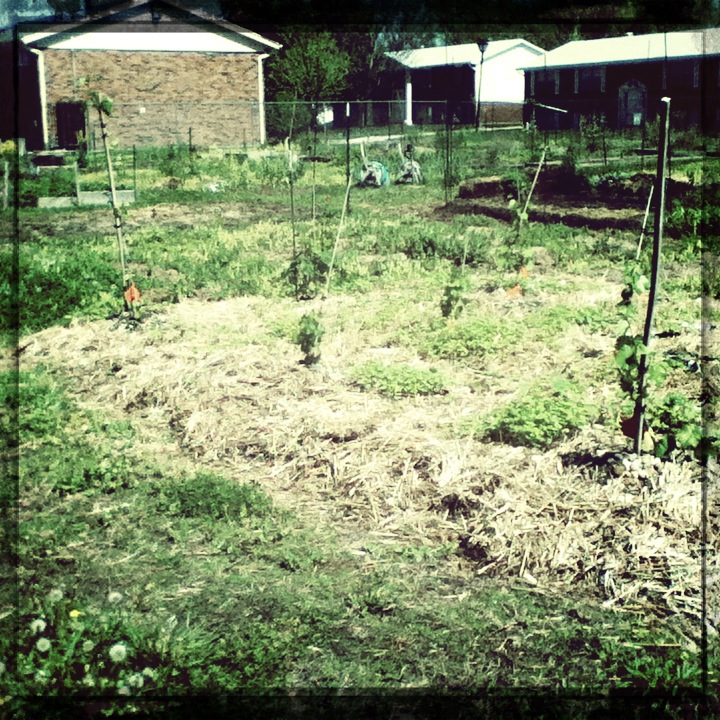
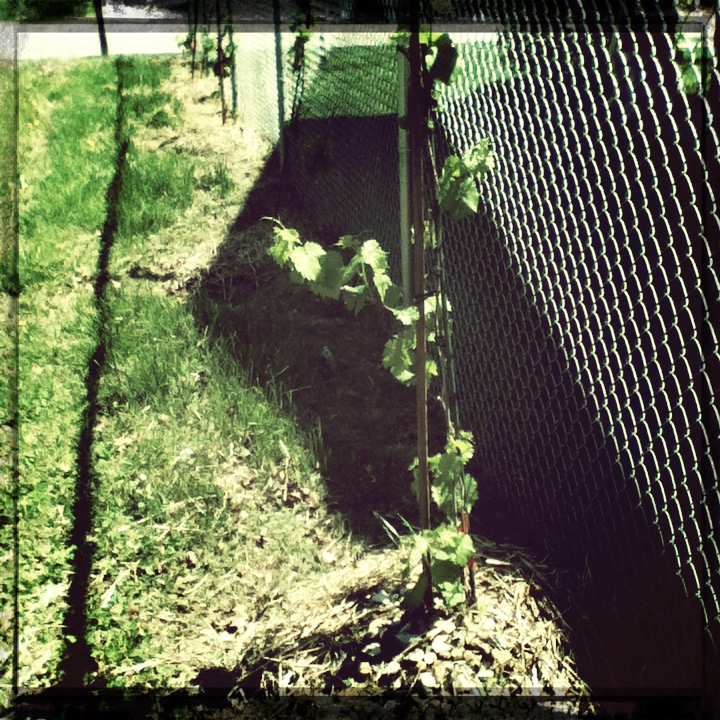
Here is a view of the wildness....
The cover crop, Japanese Buckwheat, is quite tall as can be seen. Despite it looking like a mess, the Buckwheat is bringing in the Honeybees, Bumblebees, Parasitic Wasps, Butterflies of many varieties, among other flies I cannot identify. The other gardeners are benefiting from this choice of cover crop, whether they realize it or not. Also, I have Fava Beans growing in the patch and underneath the vines along the fence on the south side of the garden. I recently broadcasted some Alyssum Seed underneath the vines on the south side, along with Organic (non-GMO) Hard Red Wheat (which was planted in the larger patch). Time will tell what grows and what doesn't. If I can get the Alyssum to take, it, too, will bring with it beneficial insects into the garden for all to benefit from.
Yesterday I threw out a few Southern Giant Mustard seeds which will improve moisture retention in the soil due in large part to its taproots which has the ability to penetrate more difficult soils. I built up the larger patch, it has been referred to by the garden manager as an 'excavation hole', but on my end of the garden after every hard rain, there is standing water for nearly a day after. Not many other places in the garden have such a feature unless there was an intended depression created by shovel work. The Mustard will improve soil quality in the long term.
Showing posts with label Buckwheat cover crop. Show all posts
Wednesday, May 16, 2012
Thursday, April 26, 2012
Update photos from mid-April 2012
Here is a cluster of photos from April 16 2012.
(These 3 photos feature my 3-year old La Crescent grape vine.)
Here is a cluster from April 19, 2012.
(The first photo is of the young Japanese Buckwheat I am using as a cover crop. The goal is to always improve the soil by increasing biomass, have something growing to compete with undesirable weeds, attract beneficial insects, and with other cover crops attempt to improve the nitrogen levels - Fava Beans, for example. Just best to never have a barren soil at any stage of the off or on-season, which implies my growing interest in utilizing summer and winter cover crops.)
(More photos of the La Crescent grape vine.)
(These 3 photos feature my 3-year old La Crescent grape vine.)
Here is a cluster from April 19, 2012.
(The first photo is of the young Japanese Buckwheat I am using as a cover crop. The goal is to always improve the soil by increasing biomass, have something growing to compete with undesirable weeds, attract beneficial insects, and with other cover crops attempt to improve the nitrogen levels - Fava Beans, for example. Just best to never have a barren soil at any stage of the off or on-season, which implies my growing interest in utilizing summer and winter cover crops.)
(More photos of the La Crescent grape vine.)
Thursday, April 12, 2012
Some Frost Damage
......to the Buckwheat cover crop only!!!! The grape vines survived the past 2 nights of 35 and 34 degree temperatures. I read a headline that a vineyard in Tennessee, perhaps a few even resorted to such means, hired a crew to fly helicopters over stands of vines to keep the cool air from damaging crop. I don't have the capacity or need to do such things, but interesting to read about none the less.
Here are a few iPod photos from Friday April 6 2012:
Lots going on with the grapevines. I was a little worried that I would lose at least 2 from this past winter, but I actually didn't lose any. The varietal in focus was the Chambourcin, it is a hybrid variety and I guess it came out in the early 1960's. I have 3 young Chambourcin vines in one location and another vine of the same variety in another. It is a later growing varietal, this is all documented in the literature that is available when researching, which I only recalled after I finally saw growth a few days ago. When I initially saw so little growth I went into a minor sadness, but lo and behold, the grapevines fought through the mild winter and produced new shoots!!!! I am delighted, absolutely ecstatic. Last year I started with 11 cuttings of the Chambourcin grape vines that I had purchased on the market. I was able to get 4 viable plants out of 11 woody cuttings. 36.36 percent success rate.
As I mentioned, I experienced a bit of frost damage last night and probably the previous night. The lowest temps were from 5AM until 8AM. The grape vines were fine. The cover crop I am using, the Buckwheat, experienced a bit of damage. The Fava Beans survived well enough. Here at home where I am starting a few cuttings, I covered them with very large plastic bags, a very functional apparatus in deflecting the cold temperatures.
In addition to this, I believe 4 vines of Concord grapes have been bequeathed to me at the Community Garden as the original owner hasn't returned to garden. It has been told to me that he is studying Viticulture and was hoping to get into the industry after his studies. Those are at least 3-year old vines. I pruned them quite a bit, but the co-leader of the garden had the idea of training them along the front fence to allow them to fan out and present a nice spread or texture other than chain-link. They have many, many inflorescenses which will eventually turn into fruit after flowering.
That's enough for now. More to come. Maybe updates on Chardonel, Norton and other cuttings in the next bulletins.
Here are a few iPod photos from Friday April 6 2012:
Lots going on with the grapevines. I was a little worried that I would lose at least 2 from this past winter, but I actually didn't lose any. The varietal in focus was the Chambourcin, it is a hybrid variety and I guess it came out in the early 1960's. I have 3 young Chambourcin vines in one location and another vine of the same variety in another. It is a later growing varietal, this is all documented in the literature that is available when researching, which I only recalled after I finally saw growth a few days ago. When I initially saw so little growth I went into a minor sadness, but lo and behold, the grapevines fought through the mild winter and produced new shoots!!!! I am delighted, absolutely ecstatic. Last year I started with 11 cuttings of the Chambourcin grape vines that I had purchased on the market. I was able to get 4 viable plants out of 11 woody cuttings. 36.36 percent success rate.
As I mentioned, I experienced a bit of frost damage last night and probably the previous night. The lowest temps were from 5AM until 8AM. The grape vines were fine. The cover crop I am using, the Buckwheat, experienced a bit of damage. The Fava Beans survived well enough. Here at home where I am starting a few cuttings, I covered them with very large plastic bags, a very functional apparatus in deflecting the cold temperatures.
In addition to this, I believe 4 vines of Concord grapes have been bequeathed to me at the Community Garden as the original owner hasn't returned to garden. It has been told to me that he is studying Viticulture and was hoping to get into the industry after his studies. Those are at least 3-year old vines. I pruned them quite a bit, but the co-leader of the garden had the idea of training them along the front fence to allow them to fan out and present a nice spread or texture other than chain-link. They have many, many inflorescenses which will eventually turn into fruit after flowering.
That's enough for now. More to come. Maybe updates on Chardonel, Norton and other cuttings in the next bulletins.
Subscribe to:
Comments (Atom)